

In 2025, MultiControl delivered and commissioned the CanisMatic Portal Scanner – a customs X-ray inspection system for cargo and vehicles – at the Koroszczyn border crossing between Poland and Belarus. The deployment significantly improved inspection efficiency and helped increase vehicle scanning throughput by up to 100%, enabling faster cargo screening while maintaining high security standards.
The project covered the complete design, engineering, manufacturing, and installation of the customs X-ray scanner, as well as the development of the entire inspection infrastructure and software to operational requirements. The system was produced in our European manufacturing facility located just several kilometers from Warsaw.
The CanisMatic Portal Scanner was delivered to the National Revenue Administration (Krajowa Administracja Skarbowa – KAS). The deployed MultiControl scanner enables fast, non-intrusive cargo screening, supporting border authorities in detecting illegal goods while ensuring smooth and efficient vehicle throughput. It enables the rapid identification of smuggled goods, including tobacco and alcohol products, as well as hazardous materials such as narcotics, explosives, and firearms.
Marcin Łoboda, Secretary of State and Head of the National Revenue Administration, commented on the implementation of the MultiControl X-ray security scanner:
The X-ray scanner is more than just advanced technology – it strengthens vigilance and improves the efficiency of border controls. It supports Customs and Tax Service officers in their daily work and becomes an important ally in the fight against smuggling and other cross-border threats.
Marcin Łoboda, Secretary of State and Head of the National Revenue Administration
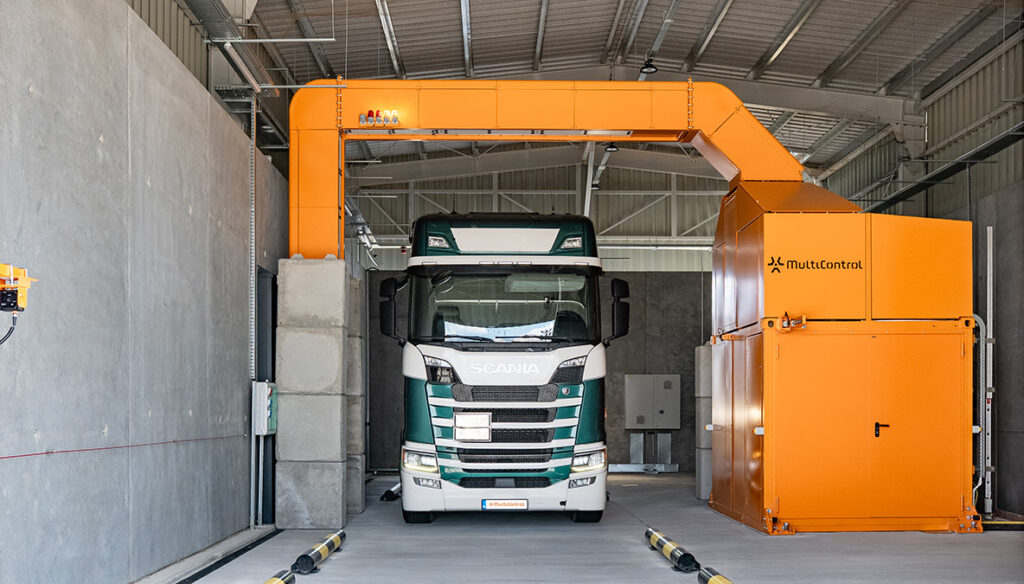
Koroszczyn border crossing – high-traffic corridor for cargo inspection systems
Koroszczyn is one of the key strategic border crossing points on the eastern border of the European Union, handling a high traffic volume of approximately 365,000 trucks annually.
The crossing is dedicated exclusively to cargo truck traffic, making efficient and reliable inspection technology essential for maintaining security and traffic flow. The checkpoint lies on a major international transport corridor connecting the European Union – including Western European cities such as Berlin and Warsaw – with Belarus and further eastern markets.
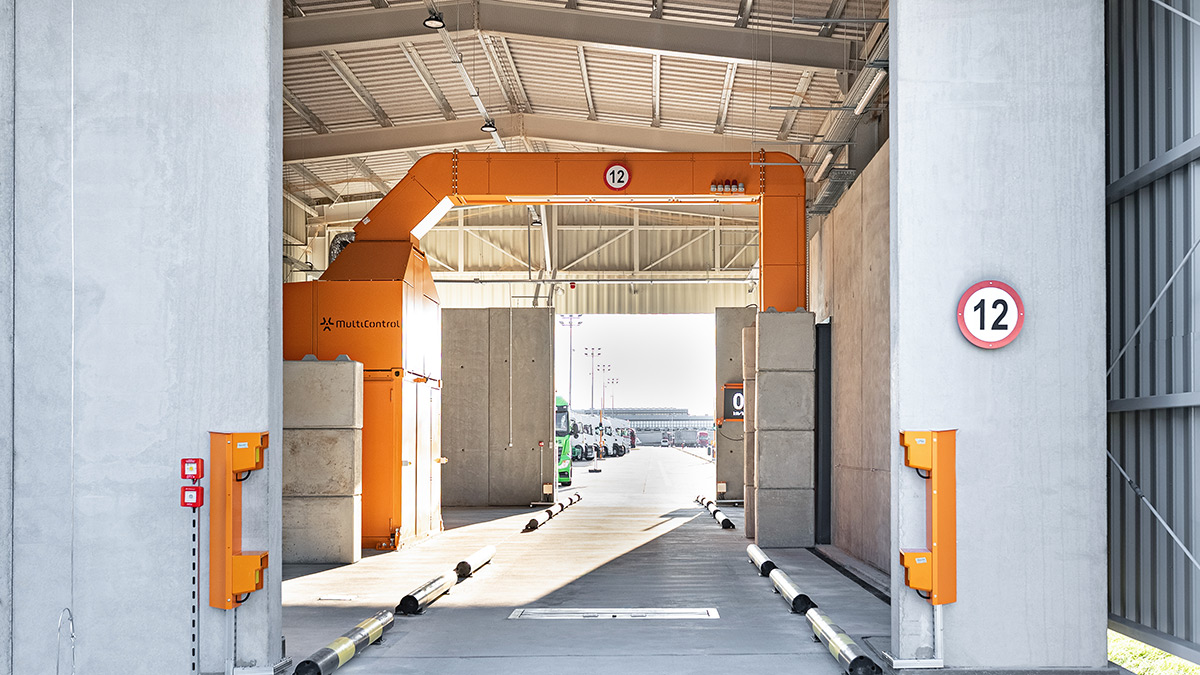
What makes the Koroszczyn border crossing unique compared to other EU checkpoints?
Unlike many mixed-use border crossings, Koroszczyn is focused entirely on heavy cargo traffic, operating under constant high load and time pressure. Its strategic location on one of the main East–West transport corridors means that even short disruptions can quickly lead to significant congestion. This makes the crossing particularly demanding in terms of inspection speed, operational efficiency, and the need for advanced, non-intrusive inspection technologies.
Border X-ray scanner for trucks and cargo – operational challenges
The main challenge at the crossing was the growing congestion and long waiting times for trucks at the border. Shortly before the deployment of the border X-ray scanner, transport companies raised concerns that the clearance process for vehicles entering Poland was far too slow. At one point, around 3,600 trucks were queued at the Polish–Belarusian border, creating a severe logistical bottleneck. Drivers were forced to wait in line for up to two weeks before being able to cross the border.
Customs X-ray inspection system – project goals and throughput increase
The primary objective of the project was to significantly improve the efficiency of border inspections and reduce truck waiting times. By deploying a modern customs X-ray scanner and optimizing the inspection process, the aim was to increase vehicle scanning throughput by up to 100%, enabling faster and more effective cargo screening while maintaining high security standards.
The solution was designed to support border authorities in handling a growing volume of cargo traffic, reducing congestion and ensuring smoother operation at one of the European Union’s key external border crossings. The deployed CanisMatic Portal Scanner – a border inspection system – operates 24 hours a day, 365 days a year, ensuring continuous inspection capability under demanding conditions.
The impact of the newly commissioned X-ray scanner was also highlighted in official communications from the Revenue Administration shortly after the system became operational, as noted by Michał Deruś, spokesperson for the Revenue Administration Chamber in Lublin.
Thanks to the commissioning of the new scanner, the throughput of the border crossing is increasing, and congestion on the Belarusian side is beginning to decrease. This will allow the complete clearance of the vehicle queue within the next few days.
Michał Deruś, spokesperson for the Revenue Administration Chamber in Lublin
Implementation of the CanisMatic Portal Scanner – X-ray inspection system components
The CanisMatic Portal Scanner – an X-ray inspection system – includes one operator control station and one image analysis workstation. Additionally, five remote analysis stations are available at the truck terminal, enabling customs officers to review and interpret X-ray scan images in real time.
What did we accomplish? Key components of the X-ray inspection system implementation
1. Design & build of relocatable containerized scanner
The CanisMatic Portal Scanner can be relocated together with the scanning canopy, as all infrastructure components, including the canopy and modular concrete shielding walls, are designed for full relocatability, enabling the system to be transferred and reinstalled at a different location. The operator container is also fully relocatable, equipped with all necessary safety systems, incorporating a server room, operator room, and social facilities.
2. Development of complete infrastructure: sanitary, electrical, and telecommunication systems
All systems delivered as part of the X-ray security scanner project have been fully integrated with the existing terminal infrastructure in full compliance with the mandatory integration requirements, ensuring seamless operation and complete compatibility with all relevant systems.
3. Access control and video surveillance systems
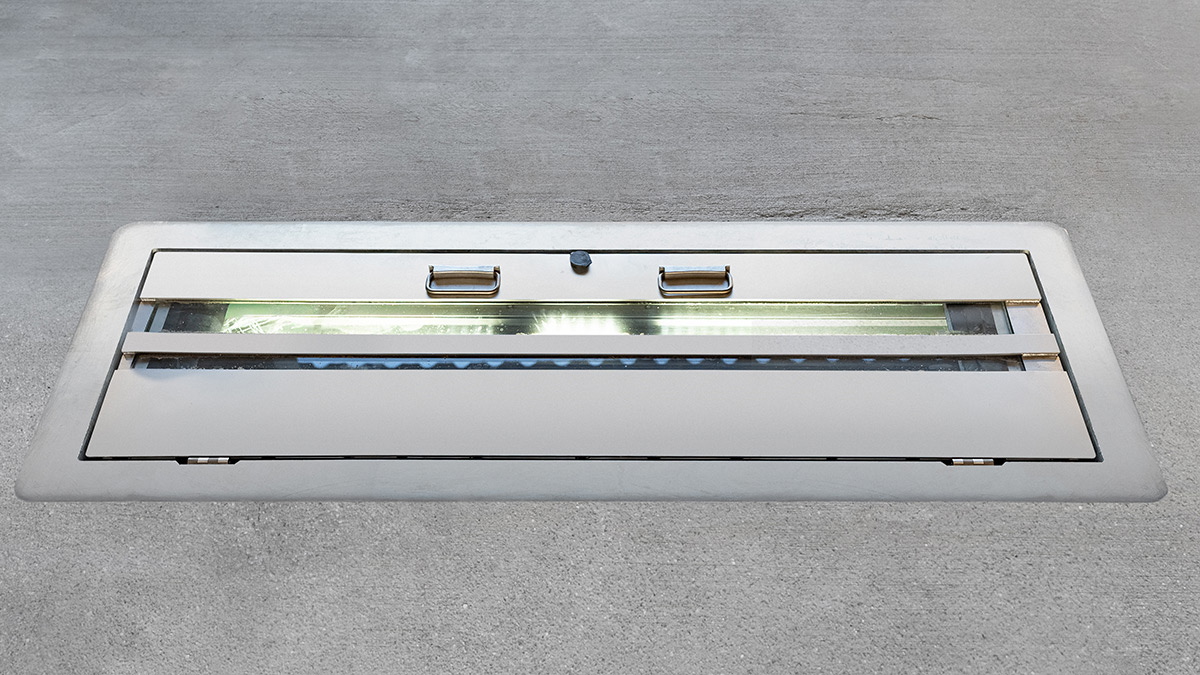
Access control and video surveillance systems ensure secure operation of the inspection area. In addition, a high-resolution UVSS camera captures detailed images of the vehicle undercarriage, complementing the X-ray scan and supporting comprehensive vehicle inspection. Integrated with the OCR system, the UVSS camera enables automatic vehicle identification and seamless data correlation throughout the inspection process.
4. Modification and enhancement of the digital system
The system is integrated with the weighbridge, where vehicle data, including registration numbers, is recorded. This information is then verified against data captured by the OCR system during inspection, reducing manual data entry and improving the efficiency and accuracy of customs checks.
In addition, the system is integrated with national border IT systems (“Cyfrowa Granica”), enabling the automatic exchange of vehicle data and inspection results. Through this integration with CG, customs officers are able to verify and control transported goods, while X-ray scan images are linked with customs records and other border control systems.
5. Software customization
Our software is fully configurable and meets the client’s requirements, providing functionalities that support the daily work of customs officers and the specific nature of inspection procedures.
6. Obtaining all required administrative approvals
As a company responsible for the end-to-end delivery of the project, we were also responsible for obtaining all necessary administrative approvals related to the implementation of the system. This included coordinating the required permits and formal procedures to ensure full compliance with regulatory requirements.
Effects of the X-ray inspection system on border security and efficiency
1. Higher throughput: faster processing, shorter queues
Faster processing enables shorter waiting times and improved traffic flow at the border crossing.
2. Fast & precise cargo inspection: detects illegal or dangerous goods
The system enables the detection of illegal or dangerous goods without unloading vehicles.
3. Dual-energy technology: distinguishes between organic and inorganic materials
Advanced scanning technology allows for accurate distinction between organic and inorganic materials.
4. Enhanced border security: spots hidden compartments & vehicle modifications
The system helps identify hidden compartments and vehicle modifications used for smuggling.
5. Automated data processing: auto license plate recognition, fewer manual errors
Automatic license plate recognition reduces manual input and improves inspection accuracy.
The implementation of the MultiControl X-ray inspection system has delivered measurable operational improvements at the Koroszczyn border crossing, particularly in terms of efficiency, throughput, and inspection effectiveness.
Thanks to the deployment of the MultiControl X-ray scanner, clearance processes at the Koroszczyn border crossing have become significantly more efficient, while border security in this section has been further strengthened. The MultiControl X-ray scanner was designed to handle up to 500 vehicles during a 12-hour shift under optimal operational conditions. With the current technical infrastructure, it is possible to scan approximately 300–400 vehicles within a 12-hour shift, which represents a significant increase compared to the capacity before the system was deployed. At this stage of operation, it can already be confirmed that the project objectives have been successfully achieved, increasing the throughput of the crossing and enabling the scanning of up to 100% of trucks entering the European Union.
Michał Deruś, spokesperson for the Revenue Administration Chamber in Lublin
The results observed in the first phase of operation confirm the positive impact of the system on traffic flow and inspection capacity. Barbara Ostrowska, Vice President of the Management Board at MultiControl, summarized the implementation of the CanisMatic Portal Scanner:
The implementation of the MultiControl X-ray scanner at the Koroszczyn border crossing has delivered the expected results. We have increased the throughput of the crossing, improved operational efficiency for customs officers, and strengthened security on one of the European Union’s key external borders with Belarus. As a result, transport through this strategic corridor has become safer and more efficient.
Barbara Ostrowska, Vice President of the Management Board at MultiControl
Łukasz Talarek, Project Team Manager at MultiControl, also commented on the results of the implementation:
The deployment was a complex end-to-end project, from design and engineering to manufacturing and installation of the system. Given the strategic importance of the Poland–Belarus border and frequent smuggling attempts, the project successfully increased vehicle scanning throughput by up to 100% while strengthening border security.
Łukasz Talarek, Project Team Manager at MultiControl
The high effectiveness of the MultiControl solution helps protect the state budget from losses related to illegal trade, while also strengthening security along key transport corridors connecting the East with the European Union.
Contact Us
Would you like to find out how our X-ray inspection systems can support your operations? Get in touch with our team.
FAQ – Border X-ray scanners and cargo inspection systems
-
What is a cargo and vehicle X-ray inspection system?
A cargo and vehicle X-ray inspection system, also known as a border X-ray scanner, is a non-intrusive technology used to inspect trucks, trailers, and cargo containers without unloading them. It enables customs and border authorities to detect smuggled goods, hidden compartments, and suspicious materials while maintaining smooth traffic flow at border crossings.
-
How does a portal X-ray inspection system work?
A Portal X-ray inspection system scans trucks, containers, and oversized cargo as they pass through a stationary scanning frame equipped with an X-ray source and advanced detectors. The system generates high-resolution images of the cargo and vehicle structure, allowing officers to identify concealed goods without opening the load. Dual-energy technology enables the system to distinguish between organic and inorganic materials, helping detect items such as cigarettes, narcotics, weapons, or undeclared goods.
-
Why are border X-ray scanners used at border crossings?
Border X-ray scanners are used to detect illegal goods such as cigarettes, narcotics, weapons, and undeclared cargo. They also improve inspection efficiency by enabling non-intrusive cargo screening, which reduces inspection times and helps maintain smooth traffic flow.
-
How do X-ray inspection systems improve border crossing efficiency?
X-ray inspection systems enable faster cargo checks compared to manual inspections. By automating image analysis and integrating with border IT systems, they reduce waiting times, increase throughput, and help prevent congestion at busy border crossings.
-
What can cargo X-ray inspection systems detect?
Cargo X-ray inspection systems can detect smuggled goods, hidden compartments, undeclared cargo, and suspicious materials. Thanks to dual-energy technology, the system can differentiate between organic and inorganic substances inside the load.
-
What is dual-energy X-ray technology?
Dual-energy X-ray technology uses two energy levels to analyze scanned objects. This allows the system to distinguish between different material types, helping customs officers identify suspicious cargo more accurately.
-
How do border X-ray scanners reduce truck queues?
By enabling fast, non-intrusive inspection of vehicles and cargo, border X-ray scanners significantly reduce the time required for customs checks. This increases throughput and helps minimize congestion at border crossings.
-
Can X-ray inspection systems integrate with other border systems?
Yes. Modern X-ray inspection systems can integrate with weighbridge systems, OCR (license plate recognition), national border IT systems, and customs databases. This enables automatic data exchange and improves inspection efficiency.
-
Are X-ray inspection systems safe for operators and drivers?
Yes. Modern X-ray inspection systems comply with strict international radiation safety standards. The scanning process is fully controlled and monitored to ensure the safety of operators, drivers, and nearby personnel.
-
Where are cargo X-ray inspection systems used?
Cargo X-ray inspection systems are used at border crossings, seaports, logistics hubs, and customs terminals. They are designed for high-traffic environments where fast and effective vehicle and cargo inspection is required.
Sources
Pierwsze efekty działania nowego skanera RTG w Koroszczynie – Ministerstwo Finansów – Krajowa Administracja Skarbowa – Portal Gov.pl
Przejście graniczne w Koroszczynie z nowoczesnym skanerem za 13,5 mln zł [FILM]
Szybsze odprawy w Kukurykach – rp.pl
About MultiControl
MultiControl is a European manufacturer of X-ray inspection systems for cargo and vehicles used by customs and border authorities. The company designs and produces road and railway X-ray scanners for the inspection of trucks, containers, and railway wagons, supporting non-intrusive inspection (NII) operations and contraband detection at border crossings, seaports, and logistics terminals.
MultiControl systems are deployed at external EU borders and along international trade routes, enabling customs administrations to conduct high-throughput inspections while maintaining traffic flow.